
By Martin Walian, Founder & CEO
MBA · Certified Export Control Manager (CECM)
Updated 11 November 2026 · 8 min read
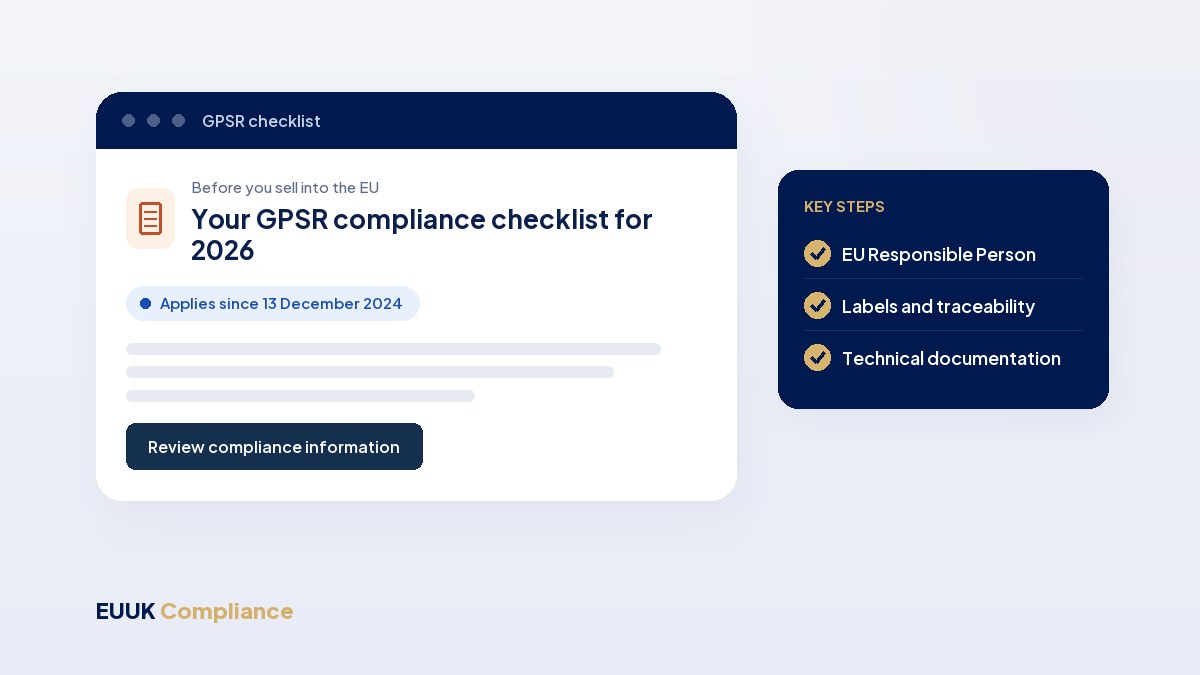
To sell consumer products into the EU from outside it, you need an EU-based responsible person, traceable labels, an internal risk analysis with technical documentation, warnings in the local language, complete online listings, and processes for complaints, accidents, recalls and records. This checklist takes each step in order and names the article of the General Product Safety Regulation (GPSR) behind it.
The GPSR is Regulation (EU) 2023/988 and has applied since 13 December 2024. Most duties sit with the manufacturer, which is usually you if you sell under your own brand (Article 13). Others sit with your EU responsible person, your importer or the marketplace.
What to do now
- Confirm the product is covered by the GPSR and whether CE-marking rules also apply.
- Appoint your EU Responsible Person and put their details on every product and listing.
- Write your internal risk analysis and technical documentation before you ship.
- Set up a complaints channel and a plan for accidents and recalls.
Missing an EU or UK Responsible Person? We can be yours, appointed within 24 hours. EU or UK from €49/month, both from €79/month.
Apply Now1. Check That GPSR Applies
The GPSR covers products placed or made available on the EU market, whether new, used, repaired or reconditioned (Article 2). It doesn’t cover medicinal products, food, feed, living plants and animals, plant protection products or antiques, among others. Selling online counts: an offer targeted at consumers in the EU makes the product available on the EU market (Article 4).
If EU harmonisation legislation covers your product, such as the toy or electrical equipment rules, that legislation comes first and the GPSR fills the gaps (Article 2(1)). The listing, accident and recall duties below still apply.
2. Appoint a Responsible Person in the EU
A product can’t be placed on the EU market unless an economic operator established in the EU is responsible for it (Article 16(1)). From outside the EU, that’s your importer, an authorised representative with a written mandate or, if there’s neither, a fulfilment service provider. For products under EU harmonisation legislation, Article 4 of Regulation (EU) 2019/1020 sets the same requirement.
- Sign a written mandate that lets your representative give authorities documents on request, inform you about dangerous products, notify measures through the Safety Business Gateway and cooperate with authorities (Article 10).
- Share your technical documentation: under Article 16(2) they must check regularly that the product matches it and the labelling rules.
See how our EU Authorised Representative service handles this, or check whether you need one.
3. Label the Product for Traceability
- Product identifier: a type, batch or serial number or other element that consumers can easily see and read, on the product or, if its size or nature doesn’t allow it, on the packaging or an accompanying document (Article 9(5)).
- Manufacturer: name, registered trade name or trade mark, and postal and electronic address, on the product, its packaging or an accompanying document (Article 9(6)).
- Responsible person: name, registered trade name or trade mark, and contact details including postal and electronic address, on the product, its packaging, the parcel or an accompanying document (Article 16(3)).
- Importer, if there is one: its own name and contact details as well (Article 11).
4. Do the Risk Analysis and Technical Documentation
Before placing a product on the market, the manufacturer must carry out an internal risk analysis and draw up technical documentation (Article 9(2)). It contains at least a general description of the product and its essential characteristics relevant to safety. Where relevant, it also covers the risks identified, the solutions adopted to remove or reduce them, and the standards applied, including which parts if a standard was only partly applied.
Keep it up to date and make it available to market surveillance authorities on request for 10 years after the product is placed on the market (Article 9(3)).
5. Add Warnings and Instructions in the Local Language
The product must come with clear instructions and safety information in a language consumers can easily understand, as decided by the Member State where it’s sold (Article 9(7)). They’re not needed if the product can be used safely and as intended without them. Importers must make sure of this too (Article 11). Plan a version for each language the countries you sell in require.
6. Put the Same Details in Every Listing
Each online offer must clearly and visibly show (Article 19):
- the manufacturer’s name, registered trade name or trade mark, and postal and electronic address;
- where the manufacturer is outside the EU, the responsible person’s name and postal and electronic address;
- information identifying the product, including a picture, its type and any other identifier;
- any warning or safety information, in a language consumers in the country of sale can easily understand.
Marketplaces must give you fields for this (Article 22(9)), and it applies to your own online shop too. See what Shopify product pages must show.
7. Set Up Complaints and Accident Reporting
- Public contact channel: a phone number, email address or website section where consumers can complain and report accidents or safety issues (Article 9(11)).
- Complaints register: investigate complaints and accident reports about dangerous products, and keep an internal register of complaints, recalls and corrective measures (Article 9(12)).
- Accident notification: if a product causes an accident resulting in death or serious adverse effects on a person’s health and safety, the manufacturer must notify the authorities of the country where it happened through the Safety Business Gateway, without undue delay (Article 20). If the manufacturer is outside the EU, the responsible person must make sure this happens.
Need your EU or UK Responsible Person fast?
- Your named EU Responsible Person in Amsterdam
- Your UK Responsible Person in London
- Appointed within 24 hours, with the details you need for your listings and your labels
EU or UK from €49/month (€490/year) · both from €79/month (€790/year)
“Really fast and super clear. Had issues finding a good Authorized Representative for EU and Responsible Person for UK under one roof, but this did the trick!”
Tom Riskin, Australia · Review on Trustpilot
8. Be Ready for Corrective Action and Recalls
If you believe a product you placed on the market is dangerous, you must immediately take corrective measures, such as withdrawal or recall, inform consumers, and notify market surveillance authorities through the Safety Business Gateway (Article 9(8)). If it comes to a recall:
- tell affected consumers directly where you can identify them (Article 35);
- use a written recall notice headed “Product safety recall”, in the language of each country concerned (Article 36);
- offer an effective, cost-free and timely remedy, normally a choice of at least two of repair, replacement or refund (Article 37).
9. Keep Your Records
- Technical documentation: 10 years after the product is placed on the market (Article 9(3)). Importers keep a copy for 10 years too (Article 11).
- Risk information for authorities, including complaints, known accidents and corrective measures: be able to present it for 10 years (Article 15(4)).
- Who supplied you and whom you supplied: six years (Article 15(5)).
- Personal data in your complaints register: no longer than five years after it was entered (Article 9(13)).
Every economic operator also needs internal processes for product safety (Article 14). If we’re your EU Responsible Person, we hold your documents for 10 years.
10. The UK: A Short Checklist
- Great Britain: the EU GPSR doesn’t apply. Under the General Product Safety Regulations 2005, producers may place only safe products on the market (regulation 5), must give consumers risk information, and must mark the product or packaging with the producer’s name and address and the product reference or batch, unless that isn’t reasonable (regulation 7).
- Who the producer is: if the manufacturer isn’t in the UK, its UK representative or, failing that, the UK importer (regulation 2). There’s no general rule that every non-UK seller must appoint a UK Responsible Person.
- Cosmetics: need a Responsible Person established in the UK and notification through the SCPN service.
- Northern Ireland: the EU GPSR applies, with a responsible economic operator in Northern Ireland or the EU.
See our UK Responsible Person service.
Frequently Asked Questions
Who does the risk analysis, me or my EU Responsible Person?
The manufacturer, which is usually the brand selling under its own name (Article 9(2)). Your responsible person checks the product against that documentation and makes it available to authorities.
Does a CE-marked product need this checklist?
Partly. The CE-marking rules come first, but the GPSR listing, accident and recall rules still apply, and the EU-based operator requirement comes from Article 4 of Regulation (EU) 2019/1020.
Do I need a different label for each EU country?
The names and addresses can be the same everywhere. Instructions and safety information must be in a language consumers in each country can easily understand, as that country decides.
Is EPR part of the GPSR?
No. Extended producer responsibility for packaging, electronics or batteries is a separate legal obligation, with EPR registration country by country.
How quickly can EUUK be my EU Responsible Person?
Within 24 hours of your application. We check your Declaration of Conformity or product documentation and tell you if anything is missing.
Sources
- Regulation (EU) 2023/988 on general product safety, EUR-Lex
- Regulation (EU) 2019/1020 on market surveillance, EUR-Lex
- The General Product Safety Regulations 2005, legislation.gov.uk
- EU Regulation 2023/988 on General Product Safety: detailed guidance, GOV.UK
- Cosmetic products guidance: Great Britain, GOV.UK
Ready for step 2?
Tell us what you sell and where. We’ll reply with a fixed quote within a few hours.