
There is a moment most brands reach about four months into selling in Europe. A marketplace suspends a listing in Germany over a packaging registration number. While sorting that out, someone mentions WEEE. Then a French authority asks about a different scheme entirely. Then a customer in the UK asks why the label says CE and not UKCA.
Nothing has gone wrong with the product. The product is fine. What has gone wrong is that Europe was treated as one market with one set of rules, and it is neither.
The uncomfortable truth is that there is no single European product compliance regime. There is a stack of overlapping ones — some harmonised across all 27 Member States, some administered country by country, some phasing in on dates spread across the next four years, and a parallel set again for the United Kingdom. No authority hands you the map, because no single authority owns it.
This is what we mean when we call it a jungle. Not that any one requirement is unreasonable, but that nobody is responsible for telling you how many there are.
Not sure which of these apply to you?
We map your full obligation set across the EU and the UK — what applies, what does not, and what is already live.
The map nobody gives you
Here is roughly what sits between a non-EU brand and legitimate sale across Europe. Not all of it applies to every product — that is precisely the point, and we will come back to it.
Product safety and market access
- General Product Safety Regulation — a single EU-wide EU Authorised Representative, established in the Union, named on your packaging
- CE marking under whichever directives your product falls into: Low Voltage, EMC, Radio Equipment, Machinery, PPE, Medical Devices
- Technical files, Declarations of Conformity, and retention of both for the required period
- Notified body assessment, where your product category demands it
Sector-specific regimes
- Toys — the new Toy Safety Regulation (EU) 2025/2509, in force since 1 January 2026
- Cosmetics — Regulation 1223/2009, with a Responsible Person, PIFs, CPSRs and CPNP notification
- Food contact materials, with their own declarations
- Medical devices, under MDR
Chemicals and materials
- REACH registration and substance restrictions
- RoHS for electrical and electronic equipment
- Substance-specific restrictions that change with each ATP
Waste and extended producer responsibility
This is the group that breaks the pattern, and the one most brands underestimate.
- Packaging EPR, now under PPWR
- WEEE, for anything electrical
- Batteries, including the ones sealed inside your product
Each of those three is a separate registration in each country where you place goods on the market — separate registers, separate portals, separate reporting cycles, separate fee schedules. This is work we do directly: we handle the registrations and the periodic reporting that follows them, across every EU market you sell into and the UK. Without valid EPR registration numbers, marketplaces suspend listings, and they rarely give notice.
The new sustainability and digital wave
- Ecodesign for Sustainable Products Regulation, in full application since 19 July 2026, with the EU Central Digital Product Passport Registry now live
- Digital Product Passports, phasing in by category — EV batteries from February 2027, textiles mid-2027, electronics, furniture and construction materials through 2030
- Cyber Resilience Act, for anything with digital elements
- EU AI Act, for products incorporating AI systems
The United Kingdom: a parallel system where nothing transfers
- UKCA marking alongside CE
- A UK Responsible Person — a separate appointment from your EU one, with a UK address
- UK packaging EPR, administered by PackUK
- UK WEEE and UK battery producer responsibility, separately again
That is not an exhaustive list. It is the part most brands hit in their first two years.
Why it is a jungle rather than a checklist
Three structural features turn a long list into something genuinely difficult to navigate.
The geography is inconsistent
Some obligations are EU-wide and some are national, and there is no logic to which is which unless you already know. Your GPSR responsible person covers all 27 Member States with one appointment. Your packaging EPR does not.
PPWR — Regulation (EU) 2025/40 — became applicable on 12 August 2026. Its Article 45 requires any producer not established in a given Member State to designate an authorised representative for extended producer responsibility in that Member State. One per country. No single window, no consolidated registration. Each country runs its own register, its own portal, its own fee schedule, in its own language.
Sell packaged goods into eight EU markets and that is eight appointments, eight registrations and eight reporting cycles — for packaging alone. Add WEEE and batteries and the same arithmetic runs again.
The timing is staggered
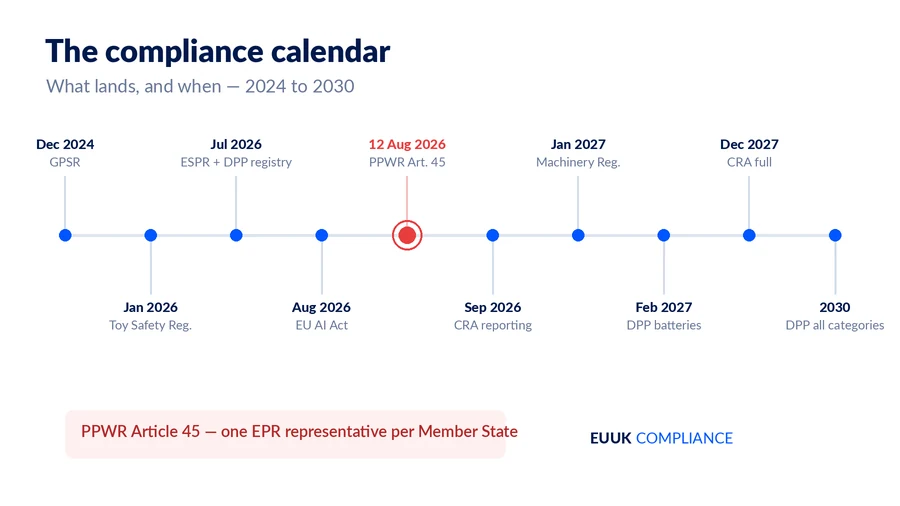
These obligations do not arrive together. They land on separate dates over a period of years, each requiring its own preparation:
| Date | What lands |
|---|---|
| 13 December 2024 | GPSR fully applicable |
| 1 January 2026 | Toy Safety Regulation (EU) 2025/2509 in force |
| 19 July 2026 | ESPR in full application; EU Central DPP Registry live |
| 2 August 2026 | EU AI Act obligations for high-risk systems |
| 12 August 2026 | PPWR applicable — Article 45 EPR representatives required |
| 11 September 2026 | Cyber Resilience Act early reporting obligations |
| 20 January 2027 | Machinery Regulation (EU) 2023/1230 replaces the Machinery Directive |
| February 2027 | Digital Product Passport for EV and industrial batteries |
| 11 December 2027 | Cyber Resilience Act full compliance |
| Mid-2027 to 2030 | DPP phases into textiles, electronics, furniture, construction |
A brand that solved its compliance problem in 2024 has been non-compliant twice over since, without doing anything differently.
Nobody owns the whole picture
National waste authorities do not talk to market surveillance authorities. Neither talks to the marketplace that suspended your listing. Your notified body has no view of your EPR registrations. There is no single inbox, and no regulator will ever send you a complete list of what you owe.
What this costs when you solve it the usual way
Most brands assemble a solution one crisis at a time. A GPSR provider when a marketplace demands one. A packaging EPR service when Germany writes. A separate one for France, because the first only covered Germany. A UK provider after Brexit. A consultant for CE marking. A lab for testing.
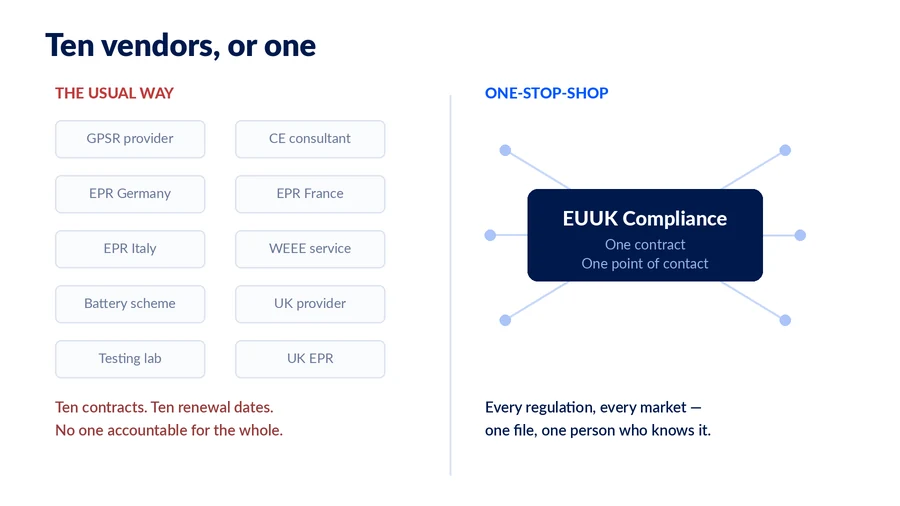
The result is a portfolio of five to twelve vendors across two continents, each holding a fragment, none accountable for the whole. That produces three predictable failures.
Gaps nobody sees
Every vendor answers for their own scope. When an obligation falls between two scopes — and with this many regimes, several do — it belongs to nobody until an authority finds it.
Renewals that go quiet
Twenty-plus registrations carry twenty-plus renewal dates across as many portals. Something eventually lapses, and you generally find out through enforcement rather than a reminder.
Nobody to call
When a listing goes down, the first hour goes on working out which vendor’s problem it is. That hour is the expensive part, because listings stay down while you’re establishing whose fault it is.
The fees are rarely the real cost of European compliance. The coordination is.
One contract instead of ten.
EUUK Compliance holds the whole file: representation, registrations, documentation and renewals, across every market you sell into.
How we cover all of it
EUUK Compliance exists to be the single point of contact for everything above. Not for one appointment — for the whole obligation set, across the EU and the UK, under one contract. We do it three ways, and we are specific about which is which.
Judgment in-house
Which obligations actually apply to your product, in which markets, in which order. What an authority is really asking for when its email arrives. Which items on that long list you can safely disregard given where you sell, what you sell and how much of it. This is the part that cannot be automated, and it is the part we do not delegate.
Local presence through a vetted partner network
Where the law requires an entity established in a specific Member State — as PPWR Article 45 does — that is a legal fact, and no provider is established in all 27 countries. We are honest about that. What we do is hold those relationships, contract with them, manage them and stand behind their work. You never contract with them, chase them or reconcile their reporting. That is our job.
Scoping to what you actually need
Most brands sell into five to eight European markets, not twenty-seven. Most products fall under three or four regimes, not fifteen. The single most valuable thing we do early is tell clients what they can ignore. A provider whose answer to every question is “yes, you need that too” is either not listening or selling.
One contract, one contact, one file
One person who knows your products, your markets, your renewal calendar and your open items — across every jurisdiction and every regime. When Spain writes, you send one email, to someone who already has the answer.
What “one point of contact” means on an ordinary Tuesday
It is easy to claim and worth being concrete about.
It means when a marketplace demands an EPR number for Italy, you do not first work out whether that is your packaging vendor or your product safety vendor. It means when the Machinery Regulation (EU) 2023/1230 replaces the Machinery Directive in January 2027, somebody has already checked whether your product is affected and told you either way. It means when your Digital Product Passport obligation arrives with your category, it is on a calendar somebody is watching.
And it means that when a market surveillance authority contacts your representative, a named person who knows your file responds — not a ticket queue, and not an automated acknowledgement.
That is the difference between having compliance vendors and having compliance handled.
Questions worth asking any provider
Before appointing anyone — including us — get straight answers to these:
- Which obligations does this cover, named individually, and which does it exclude?
- Is it EU-wide or per Member State? For EPR the honest answer is always per Member State.
- Does it include the UK, and if so which of the four UK regimes?
- Who holds the technical documentation, and for how long?
- Who responds when an authority makes contact, and how quickly?
- Who tracks renewals and upcoming regulatory dates — and will they tell you before something applies, or after?
Any provider who answers question two with “we cover Europe” has not answered it.
Talk to us about the whole picture
If you are selling into Europe and cannot say with confidence which of the obligations above apply to you, that is the normal position, not an embarrassing one. The landscape has expanded enormously in three years and was not designed with mid-sized brands in mind.
Tell us what you sell and where you sell it, and we will map your actual obligation set across the EU and the UK — what applies, what does not, what has already landed and what is coming. One conversation, one contract, one point of contact for all of it.
Every regulation. Every market. One point of contact.
Tell us what you sell and where you sell it, and we handle the rest — EU and UK, under one contract.
Frequently asked questions
Do I need an authorised representative in every EU country?
For extended producer responsibility, generally yes — in every Member State where you place packaging on the market and are not established. PPWR Article 45 requires a locally-established EPR authorised representative per Member State, with no single-window option. For product safety under GPSR, one EU-wide responsible person is sufficient.
Does my EU Authorised Representative cover packaging, WEEE and batteries?
No. Product safety representation and extended producer responsibility are separate legal obligations under separate regimes. Product safety is harmonised EU-wide; EPR is administered nationally, per country and per waste stream.
Does anything I do for the EU count for the United Kingdom?
No. The UK operates entirely separate systems for product safety, packaging EPR, WEEE and batteries, plus UKCA marking alongside CE. A UK Responsible Person is a distinct appointment with a UK address.
Which EU compliance deadlines are coming next?
Cyber Resilience Act early reporting obligations apply from 11 September 2026. The Machinery Regulation (EU) 2023/1230 replaces the Machinery Directive on 20 January 2027. Digital Product Passports begin with EV and industrial batteries in February 2027 and phase through further categories to 2030. Full CRA compliance follows on 11 December 2027.
Are batteries inside my product treated as batteries?
Yes. If you place a product containing a battery on the market, you are a battery producer for that battery, in addition to obligations for the product itself and its packaging.
Can one provider really handle all of this?
One provider can hold the contract, the coordination and the accountability, and that is what matters. The locally-established representatives required in each Member State will in practice be a managed partner network, since no single entity is established in all 27. The question to ask is who manages that network, and who you call when something goes wrong.