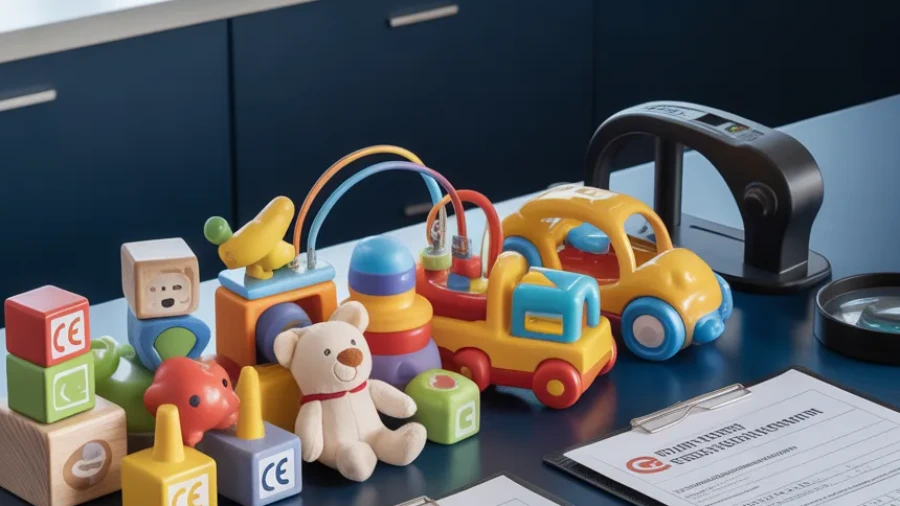
1. Why Toy Compliance in the EU Is Different
Toys are one of the most heavily regulated product categories in the European Union. Unlike general consumer goods that fall under the General Product Safety Regulation (GPSR) alone, toys must also comply with the EU Toy Safety Directive 2009/48/EC — and from August 2030, the new Toy Safety Regulation (EU) 2025/2509 that entered into force in January 2026.
If you sell a phone case or a kitchen gadget in the EU, you need GPSR documentation and an EU Authorised Representative. If you sell a toy, you need all of that plus EN 71 testing, a Declaration of Conformity, CE marking, and age-appropriate warnings on your packaging. Get any of it wrong and Amazon removes your listing. Get it very wrong and EU customs seizes your shipment.
2. Selling Toys on Amazon UK: What Is Different
If you sell toys on Amazon.co.uk from outside the UK, the EU rules in this guide do not cover you. Great Britain kept its own toy safety regime after Brexit, and the new EU Toy Safety Regulation does not apply there.
What that means in practice:
- You need a UK Responsible Person. An EU Authorised Representative does not cover the UK market, and a UK Responsible Person does not cover the EU. If you sell on both Amazon.co.uk and Amazon.de, you need both appointments.
- The UK name and address of your Responsible Person must be traceable to the product. Amazon UK asks for these details, and listings without them are suppressed the same way EU listings are.
- OPSS is the regulator. The Office for Product Safety and Standards can make enquiries about your toys, and your Responsible Person is who they contact.
- Northern Ireland is not Great Britain. Toys placed on the Northern Ireland market follow EU rules, so the EU requirements in this guide apply there.
We are an Amazon Authorized Partner, and we act as both your EU Authorised Representative and your UK Responsible Person under a single contract.
3. EN 71: The Standard Your Toys Must Meet
EN 71 is the European harmonised standard for toy safety. It is not one test — it is a series of tests covering different risk categories. The three parts that apply to virtually every toy are:
EN 71-1 covers mechanical and physical properties. This tests whether small parts can detach and become choking hazards, whether edges are sharp enough to cut, and whether the toy can withstand the kind of abuse a child will put it through. A January 2026 update (EN 71-1:2026) added new requirements for water-absorbent toys and food-imitating toys, with full enforcement from July 2027.
EN 71-2 covers flammability. Your toy must not ignite easily, and if it does catch fire, the flame must not spread rapidly. This applies to fabrics, hair, wigs, masks, costumes, and any soft materials.
EN 71-3 covers migration of certain elements — heavy metals like lead, cadmium, and mercury that could leach out of toy materials when a child puts them in their mouth. The test simulates contact with saliva and sweat and sets strict limits for 19 elements.
Depending on your toy, additional parts may apply. EN 71-7 covers finger paints. EN 71-8 covers activity toys for domestic use (swings, slides, climbing frames). EN 71-12 covers N-nitrosamines in toy materials. Your testing laboratory will determine which parts are relevant based on your specific product.
Selling toys into the EU or UK?
We act as your EU Authorised Representative and UK Responsible Person, and hold your technical file for the full retention period.
4. Who Needs to Test — And Where
If you manufacture toys outside the EU and sell them to EU customers, you are the importer under EU law. That means the testing obligation falls on you. You cannot sell an untested toy in the EU and figure out compliance later.
Testing must be performed by an accredited laboratory. You do not need to use an EU-based lab — labs in China, the US, and elsewhere can perform EN 71 testing, provided they are accredited to ISO/IEC 17025. The test reports must reference the correct EN 71 parts and clearly identify your product. Budget between €500 and €2,000 per toy depending on complexity, materials, and the number of EN 71 parts required.
Once testing is complete and your toy passes, you (or your EU Authorised Representative) issue a Declaration of Conformity. This is a formal document stating that your product meets the requirements of the Toy Safety Directive. Without it, you cannot legally apply the CE mark.
5. CE Marking for Toys
Every toy sold in the EU must carry the CE mark. This is not a quality mark — it is a legal declaration that your product conforms to all applicable EU safety requirements. For toys, that means compliance with the Toy Safety Directive and all relevant EN 71 standards.
The CE mark must appear on the toy itself, its packaging, or in the accompanying documentation. It must be visible, legible, and at least 5mm in height. Alongside the CE mark, toy packaging must include age warnings where applicable (“Not suitable for children under 36 months” with the 0–3 warning symbol), your business name and address (or your EU Authorised Representative’s), and a batch or serial number for traceability.
Do Toys Need UKCA Marking to Sell in the UK?
Not if your toy already carries the CE mark. Great Britain accepts the CE mark on toys indefinitely, so the CE mark you use for the EU also works in England, Scotland and Wales. You can use the UKCA mark instead, but then you also need a UK Declaration of Conformity.
Northern Ireland follows EU rules, so toys sold there must carry the CE mark. A UKCA mark on its own is not accepted there.
Whichever mark you use, it doesn’t replace the UK name and address that must be traceable to your toy (see section 2).
6. GPSR: The Layer on Top
Since December 2024, the General Product Safety Regulation applies to all consumer products sold in the EU — including toys. GPSR does not replace the Toy Safety Directive. It adds requirements on top of it.
Under GPSR, every product sold in the EU by a non-EU business must have a designated EU-based responsible person. For most non-EU toy sellers, this means appointing an EU Authorised Representative. Their name and EU address must appear on the product or its packaging. Amazon enforces this — listings without a valid EU responsible person are suppressed.
GPSR also requires that you maintain product safety documentation, have a process for handling product recalls, and ensure traceability throughout your supply chain. If you already have an EU Authorised Representative handling your Toy Safety Directive obligations, they can cover GPSR as well — provided the appointment agreement includes it.
7. Amazon’s Enforcement — What Actually Happens
Amazon EU marketplaces (Amazon.de, Amazon.fr, Amazon.it, Amazon.es, Amazon.nl) actively enforce toy compliance. When you create or update a toy listing, Amazon may request your EN 71 test reports, Declaration of Conformity, CE marking documentation, proof of EU Authorised Representative appointment, and product images showing compliant labelling.
If you cannot provide these within the deadline Amazon sets (typically 30 days), your listing is suppressed. If your documents are rejected — because the test report references the wrong standard, the Declaration of Conformity is incomplete, or your EU representative details are missing — you enter a back-and-forth that can take weeks to resolve while your listing remains offline.
The sellers who get hit hardest are those who launch first and sort compliance later. By the time Amazon asks for documentation, their inventory is already in FBA warehouses, and every day without a live listing is lost revenue.
One contract for EU and UK toy compliance.
Your EU Authorised Representative and UK Responsible Person, EPR registrations, and a named contact who knows your file.
8. The New Toy Rules: What Is Changing and When
The EU published its new Toy Safety Regulation (2025/2509) in December 2025, replacing the 2009 directive. It entered into force on 1 January 2026 with a transition period until 1 August 2030. During this transition, you can still sell toys that comply with the old directive — but new requirements are coming.
Key changes include stricter chemical restrictions covering endocrine disruptors, PFAS, and specific bisphenols. A Digital Product Passport will eventually replace the traditional Declaration of Conformity. Safety assessments must now cover digital features in connected toys. And the overall documentation and traceability requirements are more detailed.
You do not need to act on these changes today, but if you are developing new toys or reformulating existing ones, designing for the new regulation now will save you from retesting and relabelling in 2030.
9. Common Mistakes Toy Sellers Make
Using test reports from a non-accredited lab. Amazon and customs authorities check accreditation status. If your lab is not accredited, your test report is worthless regardless of the results.
Testing the wrong EN 71 parts. A plush toy and a chemistry set need different tests. If your test report does not cover the parts relevant to your specific product, your Declaration of Conformity is invalid.
Missing age warnings. Any toy that poses a choking hazard for children under 36 months must carry the warning. This is not optional and Amazon checks packaging images.
Confusing UK and EU requirements. A UK Responsible Person does not cover the EU market. An EU Authorised Representative does not cover the UK. If you sell on both Amazon.co.uk and Amazon.de, you need both appointments.
Assuming your freight forwarder or 3PL handles compliance. They do not. They ship your products — compliance is your responsibility as the importer.
10. What You Need Before Listing a Toy on Amazon EU
Here is the complete checklist:
- EN 71 test reports from an accredited laboratory covering all applicable parts
- EU Declaration of Conformity referencing the Toy Safety Directive 2009/48/EC
- CE mark applied to the product, packaging, or documentation
- Age warnings where applicable
- EU Authorised Representative appointed with their name and address on your packaging
- GPSR-compliant product safety information
- Batch or serial number for traceability
- Product labelling in the local language of each market you sell in
Get your toy range compliant.
Tell us what you sell and where you sell it. We map what applies, what does not, and what is already overdue.
11. How EUUK Compliance Helps Toy Sellers
We act as your EU Authorised Representative for toy products, covering both the Toy Safety Directive and GPSR requirements under a single appointment. Your EUUK Compliance representative details go on your packaging and your Amazon listings. We hold your EN 71 test reports, Declaration of Conformity, and technical files for 10 years. When Amazon requests compliance documentation, we help you respond. When a market surveillance authority contacts your representative, we handle it.
We do not perform EN 71 testing ourselves — that is done by accredited laboratories. What we do is make sure your documentation is in order, your Amazon listings have the correct compliance information, and your products have a named EU representative that actually responds when contacted.
Starting at €49/month. Credentials issued within 24 hours.
Related reading: What is an EU Authorised Representative? The GPSR guide · UK Responsible Person for Amazon sellers · Compliance pricing from €49/month